
A board game for two players
Mancala games are a family of turn-based strategy board games for two players, played with small stones, beans, or seeds placed in rows of holes or pits in the ground, on a board, or on another playing surface. The objective is generally to capture all or a specific portion of your opponent's pieces. (Wikipedia).
The mancala family includes numerous games such as oware, bao, omweso, and others.
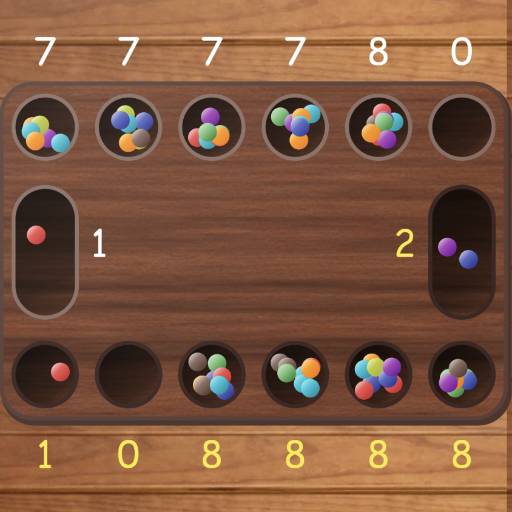
This is an implementation of several mancala games: kalah, oware, and congkak.
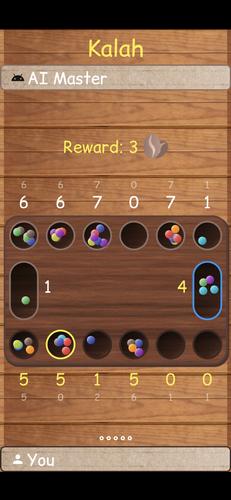
The game includes a board and a set of seeds or counters. The board consists of six small pits, known as houses, on each side, with a large pit called an end zone or store at each end. The goal is to collect more seeds than your opponent.
Kalah rules:
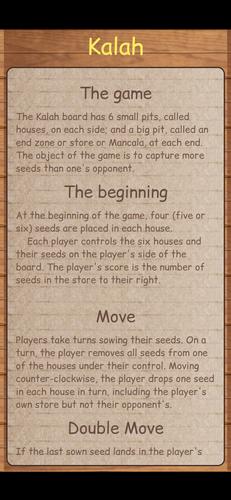
1. At the start of the game, four (five, or six) seeds are placed in each house.
2. Each player controls the six houses and their seeds on their side of the board. The player's score corresponds to the number of seeds in the store to their right.
3. Players take turns sowing seeds. On their turn, a player removes all seeds from one of their houses. Moving counter-clockwise, they drop one seed in each house in sequence, including their own store but excluding the opponent's store.
4. If the last seed dropped lands in an empty house that the player owns and the opposite house has seeds in it, both the last seed and the seeds in the opposite house are captured and placed into the player’s store.
5. If the last seed dropped lands in the player's own store, they get an extra turn. Players can take multiple consecutive turns within the same round.
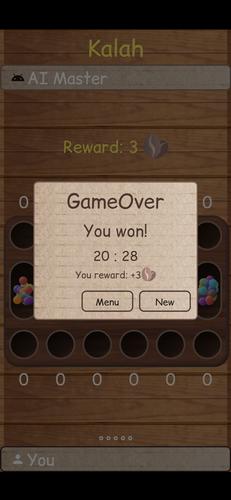
6. The game ends when one player has no seeds left in any of their houses. The opponent then collects all remaining seeds into their store. The player with the most seeds in their store wins.
Oware rules:
1. To begin, four (five, or six) seeds are placed in each house. Each player manages the six houses and seeds on their side of the board. Their score is determined by the number of seeds in the store to their right.
2. On a player's turn, they pick up all seeds from one of their houses and distribute them one by one into the following houses counter-clockwise. This is called sowing. Seeds are not placed in either player's scoring store, nor are they placed back into the house they were taken from. The starting house is always left empty; if it contained 12 or more seeds, it is skipped over, and the 12th seed goes into the next house.
3. A capture occurs only when a player’s final sown seed makes an opponent’s house contain exactly two or three seeds. The seeds in that house are captured, along with those in preceding opponent houses—provided those also contain two or three seeds as a result of the previous seeds sown—until reaching a house that does not meet these conditions or does not belong to the opponent. All captured seeds go into the player’s scoring store.
4. If all of the opponent's houses are empty, the current player must choose a move that gives seeds to the opponent. If no such move exists, the player captures all seeds in their own territory, ending the game.
5. The game concludes when a player captures more than half of the total seeds, or if both players capture exactly half (resulting in a draw).
Last updated on Aug 6, 2024 - Bug fixes
Girls Frontline 2: Exilium Global Website Goes Live, Along With Its Socials!
Top Skills to Prioritize for Yasuke in Assassin’s Creed Shadows
Marvel Rivals: Understanding Bussing and Catching It
New Game Plus in Assassin's Creed Shadows: Confirmed?
Death Stranding 2 Release Date Unveiled in Massive Trailer
Assassin’s Creed Shadows Movements Reviewed by Two Parkour Athletes
Pokemon GO Leak Teases New Adventure Effects
Amazon Music Unlimited: Free 3-Month Trial Available

FPL Fantasy Manager
Download
GT Horse Racing Games Horse 3d
Download
Little Panda: Dinosaur Care
Download
Craftsman:Kawaii House
Download
ArrowWord - Crossword Puzzles
Download
Operate Now: Hospital
Download
Maria Clara Dancing Hop Beat
Download
Tap Hero
Download
Offroad Coach Bus Simulator 3D
Download
Genesis Mutants: Cyberpunk Card Strategy
Oct 23,2026

Hyrule Warriors: Age of Imprisonment Update 1.0.2 Adds New Quests & Weapons
Oct 19,2026
Itch.io Suddenly Pulls NSFW Adult Content From Browse and Search Pages, After 'Critical' Pressure From Payment Partners
Oct 19,2026

Polytopia's Fall World Championship Begins
Oct 18,2026

“Sure, go right ahead!” Crossword Clue - Try Hard Guides
Oct 11,2026
 Category
 Download










Discover the best professional photography software! This comprehensive review features top-rated apps like ReLens Camera, PhotoKit AI Photo Editor, Pixlr, YouCam Perfect - Photo Editor, GCamera: GCam & HD Pro Photos, Photo Studio PRO, Lightleap by Lightricks, Google Camera, PhotoShot, and Photoroom. Compare features, user reviews, and pricing to find the perfect app for your photography needs, whether you're a beginner or a pro. Enhance your images with AI-powered tools, advanced editing capabilities, and stunning filters. Elevate your photography game today!
Photoroom AI Photo Editor
Photo Studio PRO
ReLens Camera
Pixel Camera
Pixlr – Photo Editor
YouCam Perfect - Photo Editor
PhotoKit AI Photo Editor